"Farewell to Lead and Fire": Laser phototypesetting technology for Chinese characters, which makes printing wash away the "lead".
Can you imagine that it took a day or two for a newspaper to go from typesetting to printing in the 1970s? A newspaper’s printing plant alone will be divided into several workshops, such as word casting, typesetting, plate casting, rotary printing, and photo-plate making.
The winter solstice is approaching. "Great course, brilliant achievements-a large-scale achievement exhibition celebrating the 70th anniversary of the founding of People’s Republic of China (PRC)" is still hot less than half a month after it closed.
In the "Reform and Opening-up" exhibition area, the "No.1 in New China: Successful Trial Production of the First Chinese Character Laser Phototypesetting Prototype" is particularly eye-catching. July 27th, 1979, is a milestone for China’s printing industry to change from the past typography to the present laser phototypesetting. In the research room on the first floor of the old library in Peking University, the first eight-size newspaper sample output by the Chinese character laser phototypesetting system was born.
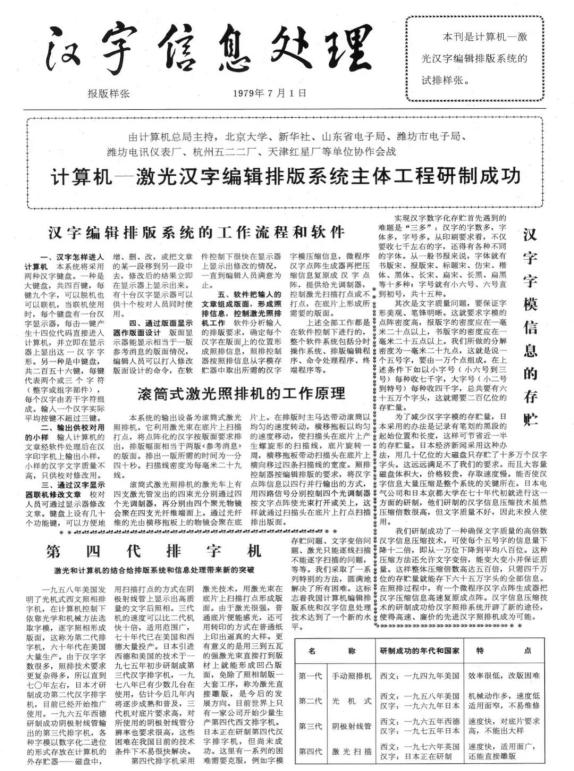
▲ In 1979, China printed the first newspaper sample with the Chinese character laser phototypesetting system. (data picture)
"In the past, word-picking was hard work, and imposition was even more physical work. After filling in the type box, it weighed dozens of pounds, and it took a lot of effort for a young man to move. Old editors know that it is not a big problem to change a word in the newspaper proof, but if one or several words are deleted, it will be in big trouble, and the compositor and the compositor have to face repeated work. " Mr. Du, who came to visit the exhibition, used to be a newspaper reporter. He leaned down and carefully studied the type plate under the exhibition board. "The adoption of laser phototypesetting system has greatly improved the publishing speed and printing quality of newspapers."
This type version also kept Ms. Cheng’s pace of viewing the exhibition. Before retiring, Ms. Cheng taught in a school in Xinxiang, Henan. "In 1987, when I first joined the work, I saw these types in the school printing room. At that time, it was necessary to give the final exam questions at least one month in advance, and it was also necessary to urgently seconde personnel from various departments to help with word picking and typesetting. The printing of a set of test questions was really a force for the whole school. "
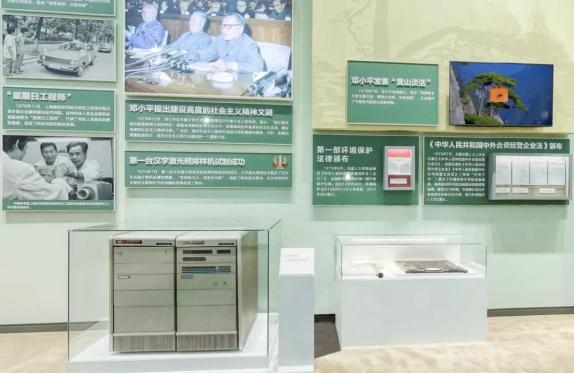
▲ In the "Reform and Opening-up" exhibition area, the "No.1 in New China: Successful Trial Production of the First Chinese Character Laser Phototypesetting Prototype" is particularly eye-catching, and four precious physical exhibits are displayed in the showcase below. (The picture comes from the online exhibition hall celebrating the 70th anniversary of the founding of People’s Republic of China (PRC).)
The reporter of China Reform News and Reform Net noticed that four precious physical exhibits were displayed in the showcase, namely, the first sample book "Sword of Wu Hao" printed by the Chinese character laser phototypesetting system in 1980, the Huaguang II system phototypesetter in 1985, the last stereotype of Economic Daily on May 21, 1987, and the newspaper film printed by the Economic Daily laser phototypesetting system. A glorious course of printing technology reform is slowly presented to the audience.
At the beginning of the last century, the west took the lead in adopting "electronic phototypesetting technology", but the printing and publishing industry in China still followed the typography and printing of "melting lead with fire and casting words with lead". Therefore, in August 1974, New China established the national key scientific and technological project "Project 748" to develop a Chinese character information processing system. The most difficult step is to get precise Chinese characters into the computer.
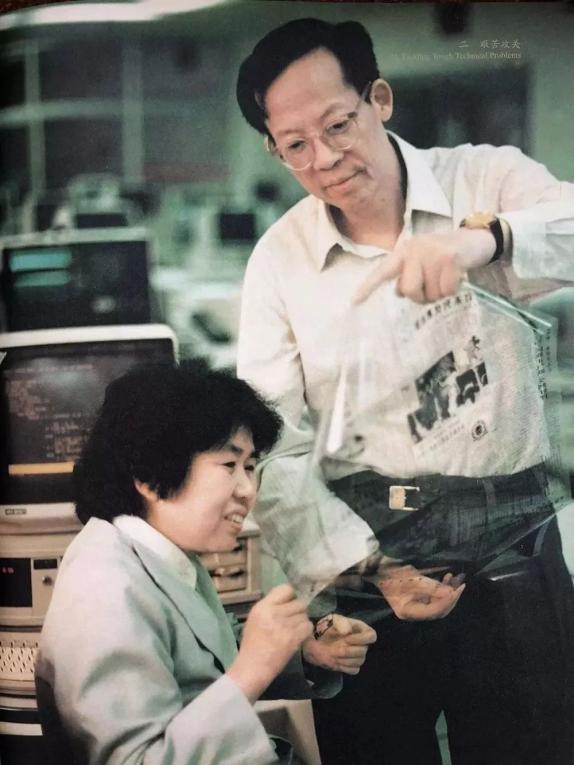
▲ Wang Xuan and his wife Oscar Chan? ? , the best partner in career. (data picture)
Wang Xuan and his wife Oscar Chan, who were still teachers in Peking University at that time? ? , participated in the research of this project. In 1975, Wang chose the unique method of "parameters represent regular strokes and contours represent irregular strokes", which greatly compressed several gigabytes of Chinese font information and stored it in a computer with only a few megabytes of memory. This is the first time that New China has stored precise Chinese characters in a computer in the world. After four years of continuous research, Wang Xuan’s team successfully exported Chinese characters from the computer by using the advanced laser phototypesetting technology at that time.
In August 1984, the domestic laser phototypesetting system was tried in Xinhua News Agency, but the operation of the phototypesetting machine was not smooth. The following year, Huaguang II system successfully passed the national acceptance and appraisal of the pilot test in Xinhua News Agency, realizing the practicality of laser phototypesetting, and produced 8 systems in total.
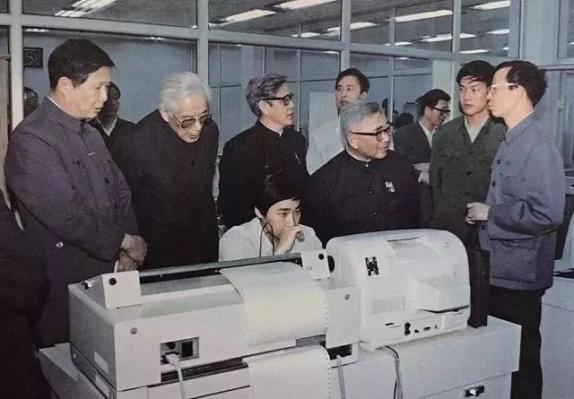
▲ In 1985, the experimental workshop of Xinhua News Agency printing plant. (data picture)
On May 22, 1987, all four pages of Economic Daily were laser-typeset, and the world’s first Chinese newspaper with computer screen assembly and full-page output was published, becoming the first newspaper in China to abolish lead typesetting. By the end of 1987, there were 48 systems in operation in China, which realized the productization of laser phototypesetting.
By 1993, famous European, American and Japanese manufacturers who came to China to develop and sell phototypesetting systems all withdrew from the China market. 99% of domestic newspapers and more than 90% of black and white books and periodicals adopted domestic laser phototypesetting systems with Wang Xuan technology as the core, which made Chinese character printing "bid farewell to lead and fire and usher in light and electricity" and created conditions for the spread and development of Chinese characters and Chinese civilization in the Internet age.
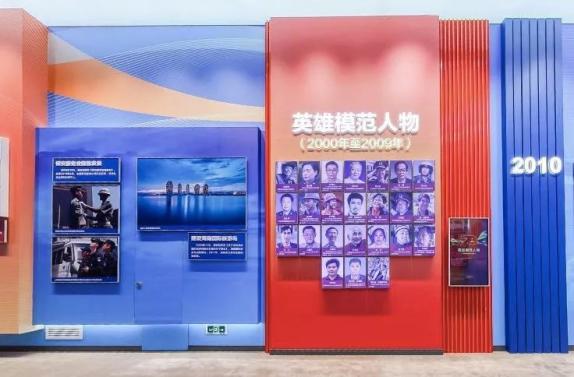
▲ The achievement exhibition builds a hero model wall with a node every ten years. The picture shows the hero model wall from 2000 to 2009. (The picture comes from the online exhibition hall celebrating the 70th anniversary of the founding of People’s Republic of China (PRC).)
It is worth noting that the achievement exhibition builds a wall of heroes and model figures every ten years, focusing on the historical achievements of heroes and model figures. On the wall of heroes and model figures from 2000 to 2009, Wang Xuan, the "father of Chinese character laser phototypesetting", was among them. He presided over the successful development of Chinese character information processing and laser phototypesetting system and Founder color publishing system, which were widely used and realized the technological revolution of China’s publishing and printing industry.
In the 21st century, e-book system based on digital copyright protection technology has been applied, and we have become accustomed to using mobile phones and computers to process Chinese information. The type used in printing in the past has evolved into a "cultural symbol".
A middle school student who came to visit the exhibition told the reporter that not long ago, she and her friends went to the bookstore to experience the principle of movable type typesetting and letterpress printing machine, and also framed the lines printed with movable type. "I feel that it used to be slow, and it is the imprint of the times that is sealed with the poetry."
(China Reform News, Reform Network reporter Fu Chaohuan)
Original title: Chinese character laser phototypesetting technology: let printing wash away "lead" China-from the 70th anniversary large-scale achievement exhibition to see the industrial transformation of China’s printing industry "farewell to lead and fire"