Jiang Zhenting, Hunan Institute of Humanities and Science: Studying regional culture, teaching and educating people.
Jiang Zhenting, a teacher at Hunan Institute of Humanities and Science.
Red Net Time Correspondent Xu Yi Liu Fang Hu Shiting Loudi Report
[Profile]
Jiang Zhenting, a native of Loudi, Hunan Province, holds a master’s degree in Chinese education from Huazhong Normal University and a doctor’s degree in linguistics and philology from Fudan University. She has been engaged in education for 28 years, and is now an associate professor at the College of Humanities and Science in Hunan, a key member of Meishan Cultural Research Base, and a director of China Rhetoric Society. He has published an academic work "Rhetoric of Xinhua Dialect" and a textbook "Basis of Chinese", presided over many provincial and ministerial-level and municipal-level topics such as "Study on Place Names in Central Hunan from the Perspective of Geolinguistics", "Study on Rhetoric of Xinhua Folk Songs from the Perspective of Transformation", and published more than 60 academic papers in well-known journals such as Journal of Nanjing Art College, Huazhong Academic and Guangming Daily. He has been awarded many honorary titles such as outstanding teacher, advanced individual in student management, advanced individual in teaching and activist in trade union work in Hunan University of Humanities and Science. Instructed students to win many awards in Hunan University Students’ Writing Competition and National Business Secretary Vocational Skills Competition. In 2020, the series of papers on rhetoric research of Xinhua folk songs won the third prize of Loudi social science achievements. In 2020, he was awarded the title of outstanding member of Loudi City of Jiu San Society, and in 2021, he was elected as the member representative of the Fifth Congress of Loudi City of Jiu San Society.
Study regional culture and inherit Meishan spirit.
Teacher Jiang Zhenting is from Lengshuijiang, Loudi, which is the core area of Gumeishan culture. The experience of growing up in Meishan cultural area gave Mr. Jiang different Meishan cultural feelings. To borrow teacher Jiang’s words, she grew up with help the king’s blood, drinking water from Zijiang, listening to Xinhua folk songs and watching Meishan Nuo Opera. Meishan culture is her root and soul.
In 2011, Ms. Jiang Zhenting passed the doctoral entrance examination for Chinese Language and Literatures of Fudan University with excellent results, and studied rhetoric under the famous scholar Professor Wu Liquan of Fudan University. When choosing a topic for her doctoral thesis, after repeated thinking and integrating her research foundation and cultural background, she finally decided to take her mother tongue, Xinhua dialect rhetoric, as an example to study the regionality of rhetoric, which was the beginning of her research on Meishan culture. After choosing the topic, Jiang Zhenting began to conduct extensive and in-depth research on dialect culture in Meishan area. From 2011 to 2015, Jiang Zhenting went to Xinhua Shuiche, Longhui Tiger Mountain, Anhua Meicheng, Lianyuan Sanjia and other places with Meishan cultural research team for many times to carry out cultural research, collected a large number of Meishan cultural research materials, and established academic exchanges with many Meishan cultural artists, enthusiasts and researchers. Four years of hard work is unusual. In 2015, her doctoral thesis "A Study on the Regional Rhetoric —— Taking Xinhua Dialect as an Example" passed the defense with almost straight A.
After graduating from Ph.D., the study of Meishan culture in Hunan University of Humanities and Science is in full swing, and the study of Meishan culture has become a business card of Hunan University of Humanities and Science. As a descendant of Meishan people and a scholar of Meishan local universities, Jiang Zhenting feels that it is his responsibility and mission to study and inherit Meishan culture. Driven by such emotions, she applied for a number of regional cultural research projects. The successful application of these local cultural projects is both an incentive and a burden for Jiang Zhenting. Since then, in the office of Meishan Cultural Research Base in the library, she can often be seen burning the midnight oil.
"How can plum blossom smell fragrant without freezing?" When winter goes, spring comes, and cold comes, Jiang Zhenting spends her time in the library, consulting materials and writing papers. Since 2020, Ms. Jiang’s achievements have been published one after another. In particular, her papers published in Guangming Daily, such as How Place Names Become the King of Topics and past lives with Different Pronunciation in Place Names, were quickly reprinted by many mainstream media such as People’s Daily, Yangguang.com, Zhongqing.com, Zhonggong.com and Sina.com, which greatly expanded Meishan Culture and Hunan College of Humanities and Science. In 2021, Jiang Zhenting’s academic monograph "Rhetoric Research of Xinhua Dialect" was published by China Social Sciences Publishing House, with more than 400,000 words, spanning two thousand years. It comprehensively described, textual researched and explained Meishan regional dialect culture, which greatly expanded and deepened Meishan cultural research.
Teach and educate people with passion and actively guide the growth of young people.
The sun and the moon are not flooded, and the spring and autumn dynasties are in order. Since teaching for more than 20 years, Jiang Zhenting has been educating and infecting students with her professionalism, spiritual temperament and personality charm. As a teacher, Jiang Zhenting has never forgotten her responsibility of teaching and educating people because she is obsessed with scientific research. Since 2006, Ms. Jiang Zhenting has worked as a class teacher for 10 years. "Come with a heart, don’t take a grass" is her creed as a teacher. Ten years’ career as a head teacher, including eight years of junior college classes, students in which the foundation is weak, the entrance examination for postgraduate entrance examination is limited, and they are prone to self-abasement and self-limitation. Therefore, as soon as Mr. Jiang takes over the new class, he will carry out inspirational education for the whole class and inspire them with the successful cases of previous students. Under her careful guidance, in 2019, Liu Guizhi, a student in her class, successfully upgraded to a junior college and was admitted to the graduate school in beijing international studies university. In 2021, there were 24 students in the 1802 class of language teaching she took, and there were countless other teachers who were admitted to the college. Recalling her career as a head teacher, Jiang Zhenting said that 2015-2018 was her most difficult three years. In 2015, she just took over 1502 classes of language teaching, and all kinds of difficulties came one after another. Her father was paralyzed by a stroke, and her daughter was facing the college entrance examination. Her teaching and research work was very heavy, but the head teacher’s work was a job that needed care and patience. She wanted to quit this job from the College of Liberal Arts, but the students could not bear it. For a long time, the style of study and achievements of her class have been well received by peers.During the school period, there were no accidents and no debts.
"Teacher, so preach and teach to solve doubts." "In addition to the work of the class teacher, there are many responsibilities as a teacher. But since I have chosen this career, I am willing to do my best to do every job well. " For a long time, Jiang Zhenting has been giving lectures on the core course Modern Chinese in the College of Liberal Arts. In 2017, according to the changes in the training objectives and paths of the newly-established majors "Secretarial Studies" and "Network and New Media" in the College of Liberal Arts, she proposed to reform the Chinese courses of these two majors. After the curriculum system was reset, there was a lack of suitable teaching materials, so she was busy compiling teaching materials with other Chinese teachers. Compiling Chinese textbooks needs to print a lot of pinyin symbols, which easily leads to confusion. From 2018 to 2020, she worked day and night in the library to carefully compile the new textbooks and repeatedly clear the school, so cervical spondylosis worsened many times. However, in order to let students use the new textbooks as soon as possible, she gritted her teeth and finally published the textbook "Basic Chinese" edited by the editor-in-chief before the freshmen of 2020 entered the school. The textbook is complete in knowledge and practical, which provides a high-quality textbook for non-Chinese majors’ Chinese learning and makes an important contribution to the discipline construction of the College of Liberal Arts.
In class, Jiang Zhenting attracts students with her profound learning and humorous style. It has been highly praised in various teaching evaluations and praised by the school’s teaching supervision group many times. She is careful and strict with students’ thesis writing, postgraduate entrance examination and various competitions. Under her full guidance, many students in the College of Liberal Arts have been admitted to graduate schools in well-known universities in China. When talking about students who have successfully taken the postgraduate entrance examination, Mr. Jiang will blurt out a long list of names: Zhou Kai, Zou Meifang, Zhang Xia, Kuang Chen, Zhong Hongchao, Wang Yin, Hu Shuan … Hunan University, Capital Normal University, Huazhong Normal University, Hangzhou Normal University …
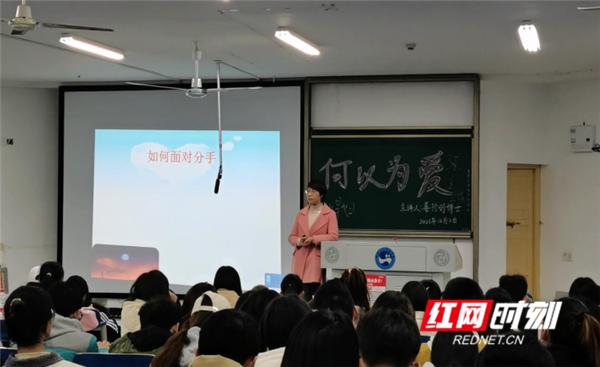
Jiang Zhenting pays close attention to and attaches importance to guiding students’ growth, and makes every effort to help them. Students from poor families will do everything possible to provide financial assistance. Teacher Jiang doesn’t want to reveal more about his various subsidies to poor students. It just means that they have all passed through the difficult period, lived a happy life, and become people who have contributed to the country and society, realizing her original intention of helping them. When she meets students with psychological problems, she carefully guides them and eliminates many signs in the bud. In 2020, some students in her class suffered from severe depression, but the parents of the students were rural and had limited knowledge of mental illness. They thought that the children were disobedient. After being patiently and meticulously explained by Teacher Jiang, they finally agreed to come to the school to take their children for active treatment. Due to lack of life experience and weak psychological endurance, young students are prone to paranoia and problems in love. In 2021, at the request of students, she gave a lecture entitled "Why Love" in the whole school. On the day of the lecture, the audience was full, which aroused great repercussions among young students and established a correct outlook on life and love for students.
Some students said that Teacher Jiang was their idol. Some students said that when I encounter problems, I just want to go to the library to sit with Teacher Jiang. I don’t say anything. I feel calm when I smell the book and look at the teacher. "True education is a process of mutual affinity. Only when it comes from the heart can it reach the depths of people’s hearts." Jiang Zhenting has never subdued or preached to her students. She just infects and inspires every student with her academic spirit and the feelings of caring for the world. She is an active practitioner of "the art of teaching is not to impart skills, but to be good at inspiring, awakening and inspiring".
Reporting/feedback